
By Tadija Šarić, Yiwu, China. In China since 2014.
Freight is getting cheaper on some lanes and more expensive on others, Washington has new tariff plans, the yuan is at its strongest in four years, and the 2027 Chinese New Year calendar is now official. Here is what happened and what to do about it, in plain language.
1. Freight rates keep falling, but Asia–Europe gets more expensive from 1 December
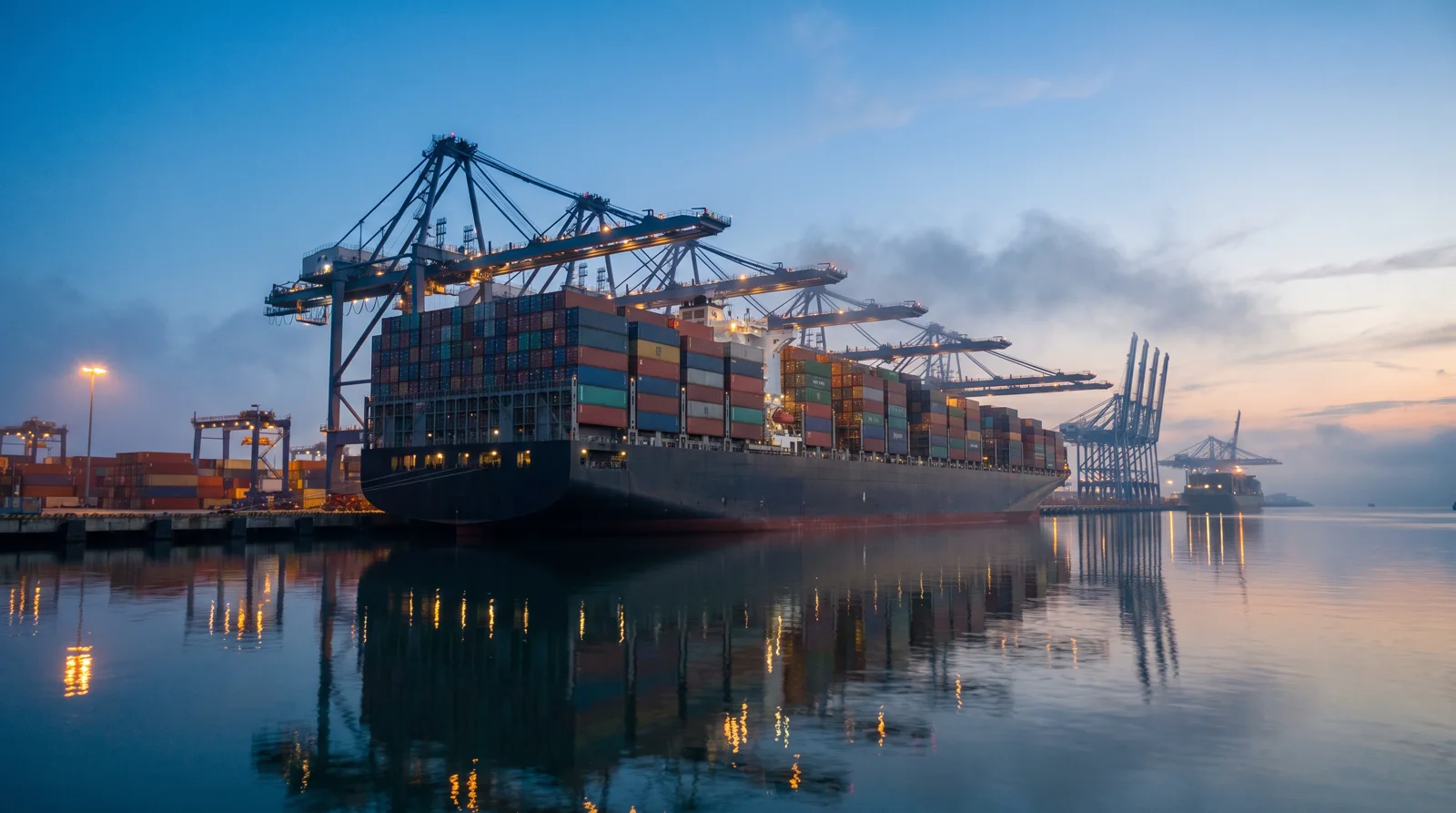
What happened. Drewry’s World Container Index fell 3% to $4,032 per 40ft container on 26 November, the fifth weekly drop in a row. Most of the drop is on routes to the US: Shanghai–Los Angeles fell 8% to $6,437 and Shanghai–New York fell 7% to $7,615. Europe is different. Shanghai–Rotterdam stayed flat at $3,485, Shanghai–Genoa rose 8% to $4,802, and many carriers have announced peak season surcharges of $1,000–$1,500 per 40ft on Asia–Europe from 1 December, with higher FAK rates of $4,500–$4,600 (North Europe) and $6,400–$6,800 (Mediterranean).
| Route (40ft container) | 26 Nov 2026 | Week-on-week |
|---|---|---|
| Shanghai → Rotterdam | $3,485 | 0% |
| Shanghai → Genoa | $4,802 | +8% |
| Shanghai → Los Angeles | $6,437 | −8% |
| Shanghai → New York | $7,615 | −7% |
| Drewry WCI (composite) | $4,032 | −3% |
Source: Drewry World Container Index, 26 November 2026. From 1 December: Asia–Europe PSS +$1,000–1,500.
What it means for you. If you import into Europe, the cheap window is closing. December demand before Chinese New Year usually pushes rates up, and Drewry expects increases “in the coming weeks”. US-bound cargo is still getting cheaper, as carriers cancel sailings because demand is weak.
Tips:
- Europe: if your goods are ready, book containers that load before 1 December or get your forwarder to confirm in writing whether the surcharge applies to your booking.
- Ask for an all-in quote (base rate + PSS + BAF + port fees). Surcharges added after booking are the most common surprise on December invoices.
- US: don’t rush. Rates are still falling, so compare two or three quotes before you book.
- Blank sailings rose to seven for next week. Keep a buffer of one week in your delivery promise to your own customers.
2. Ships are returning to Suez: shorter transit to Europe in Q1 2027, with a messy transition

What happened. Container lines are steadily moving Asia–Europe services back to the Red Sea and Suez Canal. Seatrade Maritime reports that transits are above 50% of pre-crisis levels and that a full return is expected in Q1 2027, with ONE and HMM next in line. Drewry counted 60 vessels through the canal last week.
What it means for you. Through Suez, ships from China to Europe save about 10–14 days compared with the route around Africa. That means faster delivery and, as more capacity is freed, downward pressure on rates in 2027. The transition period is where the risk is: changed rotations, ships arriving in bunches and congestion at European ports, which Drewry already flags as a concern.
Tips:
- When you book, ask which route your vessel takes (Suez or Cape of Good Hope). The difference in arrival can be two weeks.
- Don’t promise your customers the new, shorter transit time until your line has run the route for a few weeks.
- If you sign annual freight contracts now, ask for a clause that adjusts rates when the full Suez return happens.
3. The US proposes new tariffs: China at 20% on top of existing duties

What happened. On 25 November the US Trade Representative proposed new Section 301 tariffs on 14 economies, including China and the EU, after investigations into “excess capacity”. For China the proposed rate is 20%, which a senior US official said comes on top of the existing ~25% duties, so around 45% in total for many goods. For the EU, Japan and others, rates of about 15% in line with recent trade deals. US Trade Representative Jamieson Greer said the tariffs won’t take effect for at least “a couple months”, after hearings and public comment. China called the tariffs “political manoeuvring”, while also extending its trade truce with the US by two months.
What it means for you.
- US buyers: you probably have a window until early 2027. Goods that land before the new rate applies pay today’s duty.
- European and other non-US buyers: when US demand gets more expensive, Chinese exporters push harder into other markets. Expect more flexible MOQs and more room to negotiate on price in 2027.
Tips:
- US importers: plan Q1 orders to ship before the effective date, and check the HS codes of your products against the USTR proposal.
- Everyone else: use it in negotiations. Ask suppliers for 2027 prices now, and get offers from two or three factories for the same item.
- Watch for the EU’s response. When Chinese goods are diverted, Brussels has historically answered with anti-dumping checks on sensitive categories (steel, e-bikes, solar, ceramics).
4. The yuan is at a four-year high: factory quotes in USD will move up

What happened. The yuan traded at about 6.66 per US dollar on 27 November (Reuters), on track for a third weekly gain. The People’s Bank of China’s daily fixing reached its strongest level since 2022. Compared with a year ago, when it was above 7.07, the yuan is about 6% stronger.
What it means for you. Chinese factories pay workers and materials in yuan. When each dollar buys fewer yuan, their margin on a USD price shrinks, and they raise USD quotes or shorten how long a quote is valid. A price you got in September may not be valid in December.
Tips:
- Ask for a written quote with a validity date (e.g. “valid until 31 December 2026”) before you confirm.
- On repeat orders, confirm the price and pay the deposit at the same time. The deposit fixes the deal.
- Compare quotes in RMB and in USD. Sometimes the RMB price is the factory’s real number, and the USD price has a currency buffer built in.
- If you buy in EUR, watch EUR/USD as well: your real cost depends on both rates.
(This is practical purchasing advice, not financial or investment advice.)
5. Chinese New Year 2027 is official: 5–13 February. Your real deadline is in December

What happened. China’s State Council has published the 2027 holiday calendar. The Spring Festival holiday runs from 5 to 13 February 2027 (New Year’s Day is Saturday, 6 February), with make-up working days on 31 January and 14 February.
What it means for you. The official holiday is nine days, but production stops for much longer. Many factories slow down from mid-January, workers travel home early, and full output often doesn’t come back until late February or early March. Forwarders already expect the last pre-holiday sailings around 22–24 January.
Tips:
- Place orders that must ship before CNY by mid-December. Most factories need 25–30 days of production.
- Book containers for early January now. Space before CNY always fills up first.
- Schedule your quality inspection before goods are packed, not in the last week before the holiday, when inspectors are fully booked.
- After the holiday, new and returning workers mean higher quality risk. Inspect the first post-CNY production more carefully.
- If you plan to visit China, avoid roughly 25 January–25 February. Many markets and factories are closed or half empty.
Need a team on the ground?
We are a sourcing and export team based in Yiwu, working since 2014 with importers worldwide. You talk to suppliers directly and see the real factory prices. We handle supplier checks, quality control, consolidation and shipping. Our commission is among the lowest on the market, and there’s no minimum order.
Send us your product list → and we’ll tell you what can still ship before Chinese New Year.
Sources: Drewry WCI via DCN, 27 Nov 2026 · Shipping Telegraph, WCI week 48 · Seatrade Maritime: full Suez return by Q1 2027 · CNBC: US proposes new tariffs on 14 trading partners · USTR press release · Reuters via Business Recorder: yuan · Beijing Government: 2027 public holiday schedule
